
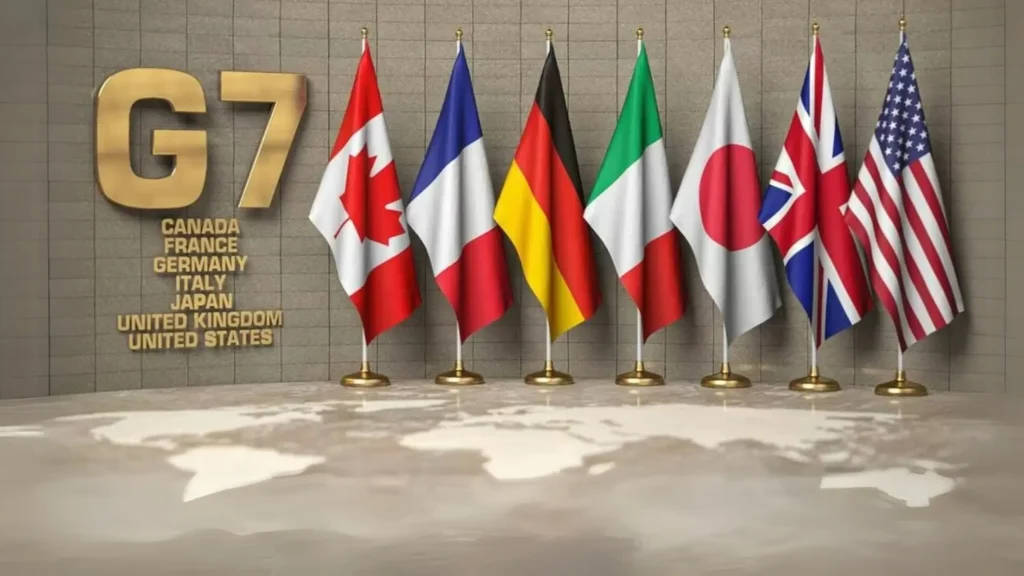
The leaders of the world’s most advanced economies have gathered in the remote Canadian mountain town of Kananaskis for the 51st G7 Summit 2025, taking place from June 15–17. But this year’s meeting is anything but routine-global crises, geopolitical rifts, and the dramatic return of Donald Trump have cast a long shadow over the discussions.
Hosted by Canadian Prime Minister Mark Carney, the summit brings together leaders from the United States, Canada, France, Germany, Italy, Japan, and the United Kingdom, along with European Union representatives. A number of non-G7 heads of state-including India’s Narendra Modi, Mexico’s Claudia Sheinbaum, and South Africa’s Cyril Ramaphosa-are also expected to participate.
A Summit Under Strain
Tensions are running high even before the opening speeches. The most pressing concern is the escalating conflict between Israel and Iran, following Israel’s dramatic airstrikes on Iranian nuclear and military sites just two days prior. With fears of an all-out regional war brewing, much of the summit’s focus is expected to shift toward urgent diplomacy.
Donald Trump’s return to the G7 table-after a volatile exit in 2018-has added a layer of unpredictability. Since re-entering office, Trump has imposed sweeping tariffs on almost every G7 member, reigniting trade tensions across the board. Though many countries have scrambled to secure trade deals with Washington, only the UK and China have reached provisional agreements. The rest remain in limbo.
Who’s at the Table?
While the seven G7 nations and the EU form the core, Canada’s invitation list has stirred controversy. Prime Minister Carney has extended an invitation to Indian Prime Minister Narendra Modi, despite lingering tensions over the 2023 assassination of a Sikh separatist in Canada-an incident that India was accused of orchestrating. Sikh advocacy groups in Canada have criticized the move, calling it “a betrayal.”
Carney defended the decision by highlighting India’s economic influence and recent improvements in bilateral law enforcement dialogue.
Also invited are Ukrainian President Volodymyr Zelenskyy, Saudi Crown Prince Mohammed bin Salman (whose attendance is unconfirmed), and leaders from Australia, Brazil, Indonesia, and South Korea.
What’s on the Agenda?
Officially, the G7’s agenda includes three themes:
- Protecting global communities
- Advancing energy security and digital innovation
- Building future partnerships
But the Israel-Iran conflict is expected to dominate conversations. Experts suggest that G7 leaders will press Trump on what went wrong in diplomacy and whether the U.S. plans to rein in Israeli aggression before the crisis deepens(G7 Summit 2025).
Aside from the Middle East, trade is another major concern. Trump’s “America First” policies have created friction among allies. While Canada and Mexico narrowly avoided fresh tariffs by enhancing border controls, most G7 nations still face punitive duties. The EU and Japan are working under pressure to reach agreements before Trump’s 90-day tariff pause ends on July 9.
Meanwhile, Trump’s unpredictable approach is keeping everyone on edge. In 2018, he famously withdrew U.S. support for the G7 joint communique, accusing then-Canadian Prime Minister Justin Trudeau of being “dishonest and weak.” This year, insiders believe he may tread more carefully-the U.S. is set to host the G7 in 2027, and Trump likely wants to preserve the stage for a grand geopolitical show in two years.
China, Russia, and Global Development
Behind the headline crises, concerns about China’s trade practices and military assertiveness in the South China Sea are also expected to surface. G7 leaders may discuss how to counter China’s nonmarket policies, such as state subsidies and heavy foreign lending, without escalating economic tensions.
In Russia, the G7 remains deeply divided. While the UK and EU recently imposed new sanctions on Moscow, Trump has refused to follow suit, citing ongoing talks with President Vladimir Putin. Still, support for Ukraine remains a shared priority, especially with Zelenskyy attending.
Global development and aid, particularly in Africa, may receive less attention this year. The Trump administration has cut USAID funding and health aid programs, citing a focus on domestic issues. This move is likely to be met with concern by European allies, who still consider development a G7 priority (G7 Summit 2025).
Sideline Diplomacy: Key Bilateral Talks
Several high-stakes side meetings are expected:
- Trump–von der Leyen & Trump–Ishiba: The U.S. president is scheduled to meet European Commission President Ursula von der Leyen and Japanese PM Shigeru Ishiba to hash out potential trade deals.
- North American Trilateral: Trump, Carney, and Sheinbaum may meet to discuss trade, fentanyl trafficking, and border security, following February’s near-miss on U.S. tariffs.
- Trump–Ramaphosa: After controversial comments about “white genocide” in South Africa, Trump and South African President Cyril Ramaphosa will meet again-marking a tense diplomatic moment after the U.S. offered asylum to 59 white South Africans earlier this year.
Outlook: Fragile Unity in an Unstable World
As the summit begins, leaders are walking a diplomatic tightrope. With multiple global crises, economic uncertainty, and political divisions within the group, this year’s G7 may test the very foundations of the alliance.
Whether the summit ends with a show of unity-or another Trump-led walkout-remains to be seen.
Source: Aljazeera
Read More : G7 Drama: Trump Returns, Modi Invited, Iran-Israel Clash