
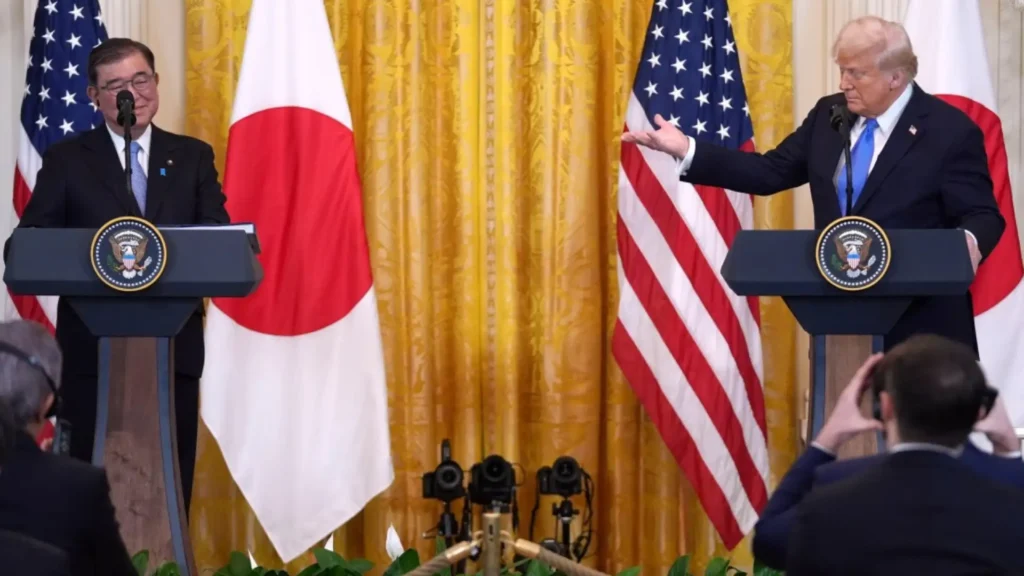
Washington/Tokyo – U.S. President Donald Trump has finalized a major trade agreement with Japan, lowering tariffs on automobile imports and shelving a wave of new levies on Japanese goods in exchange for a $550 billion investment and loan package from Tokyo aimed at strengthening supply chains and boosting U.S. manufacturing.
The deal is among the most substantial agreements Trump has sealed since launching a wave of global tariffs in 2024, and it sparked an immediate rally in Japanese markets. Tokyo’s Nikkei index surged over 3%, hitting a 12-month high, with shares of major automakers Toyota and Honda jumping 14% and 12% respectively.
“I just signed the largest TRADE DEAL in history with Japan,” Trump declared on his Truth Social platform. “This is a very exciting time for the United States of America, and especially for the fact that we will continue to always have a great relationship with the Country of Japan.”
Key Elements of the Deal
- Auto Tariffs: Existing U.S. tariffs on Japanese vehicles will be reduced from 25% to 15%. Planned additional tariffs on other Japanese goods have also been canceled.
- Investment Package: Japan committed to up to $550 billion in loans and guarantees via state-backed financial institutions to help Japanese companies build resilient supply chains, especially in strategic sectors such as pharmaceuticals and semiconductors.
- Agricultural Imports: Japan will expand its purchases of U.S. agricultural goods, notably rice, although Tokyo insisted the agreement does not undermine its farmers.
Mixed Reaction in the U.S.
While the deal was welcomed by financial markets and Japanese exporters, U.S. automakers expressed dissatisfaction.
“Any deal that charges a lower tariff for Japanese imports with virtually no U.S. content than the tariff imposed on North American-built vehicles with high U.S. content is a bad deal for U.S. industry and auto workers,” said Matt Blunt, President of the American Automotive Policy Council, representing GM, Ford, and Stellantis.
Ishiba Backs Deal Amid Political Fallout
Japanese Prime Minister Shigeru Ishiba, expected to resign following a poor election performance, welcomed the deal as a major diplomatic and economic win.
“It’s the lowest figure among countries with a trade surplus with the U.S.,” Ishiba said, referring to tariff cuts.
Ishiba also confirmed Japan would increase U.S. rice imports, but assured domestic critics that the agreement “did not sacrifice Japanese agriculture.”
Broader Implications and Momentum
The deal has triggered broader optimism across Asia. South Korean car stocks rose in hopes of a similar agreement with Washington. The Japanese yen firmed slightly against the dollar, while European and U.S. equity futures also climbed.
Economists suggested the agreement could help Japan avoid recession.
“With the 15% tariff rate, I expect the Japanese economy to avoid recession,” said Kazutaka Maeda of Meiji Yasuda Research Institute.
Japan remains the largest foreign investor in the U.S., with total assets of $2 trillion in American markets. The Bank of Japan reports $1.2 trillion in direct Japanese investment in the U.S. as of end-2024, and $137 billion in new flows last year.
Pipeline Talks and Future Deals
Speaking at the White House, Trump expressed optimism about further cooperation, specifically around a long-planned LNG gas pipeline in Alaska, indicating Japan is “all set to make that deal now” via a joint venture.With an August 1 deadline looming for further global tariff hikes, Trump’s administration is racing to finalize additional trade deals. Talks are ongoing with the European Union, and framework agreements have been announced with Britain, Vietnam, and Indonesia. Meanwhile, the U.S.-China tariff battle remains paused, pending further negotiation.